
Designing a Regulated Architecture for Reusable Agentic Products
Context
As organisations begin to explore agentic AI, the initial focus is often on individual use cases. A proof of concept is developed. A pilot is launched. A specific workflow is improved.
But in regulated environments, this approach quickly reaches its limits.
The real challenge is not building a single agentic solution. It is building an architecture that can support many — across different domains, teams, and levels of maturity — while still meeting the expectations of governance, validation, and operational control.
In this case, a global life sciences manufacturer was not looking for another isolated AI solution. The objective was to establish a foundation that could support a portfolio of agentic products, from early experimentation through to enterprise deployment.
The Challenge
The organisation faced a structural tension.
On one side:
The need to move quickly with new AI capabilities
Pressure to explore multiple use cases in parallel
A growing pipeline of potential agentic applications
On the other:
Regulated delivery requirements (validation, traceability, documentation)
The need for consistency across systems and teams
The risk of fragmentation from isolated POCs
Without a coherent architecture, each new solution risked becoming a standalone effort — duplicating components, diverging in design, and creating long-term maintenance and compliance challenges.
The question was not just how to build agentic systems, but how to do so repeatably, safely, and at scale.
Our Approach
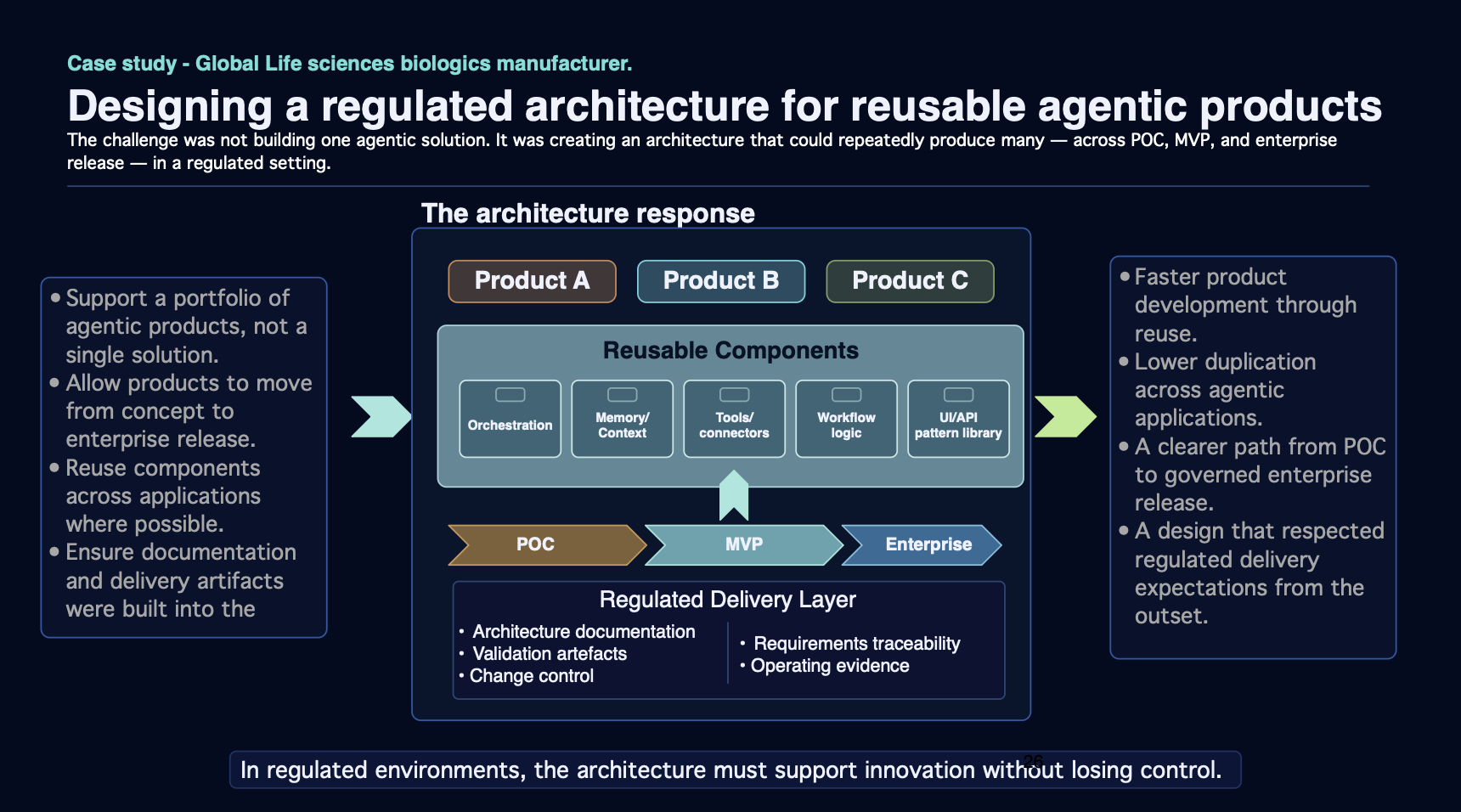
We designed an architecture centred on reuse, progression, and regulatory alignment.
At its core was a reusable component layer that could support multiple agentic products. This included:
Orchestration to manage agent workflows and execution
Memory and context management to maintain state across tasks
Tooling and connectors to integrate with enterprise systems
Workflow logic frameworks to structure agent behaviour
Pattern libraries to standardise common agentic designs
This layer acted as a shared foundation across products, allowing capabilities to be built once and reused across applications.
Crucially, the architecture was not static. It supported a clear progression:
POC → MVP → Enterprise
Rather than rebuilding at each stage, solutions could evolve along a defined path, increasing in robustness, governance, and integration as they matured.
Beneath this sat a regulated delivery layer, ensuring that architecture and delivery artefacts were not an afterthought but built into the system from the outset. This included:
Architecture documentation aligned to enterprise standards
Validation artefacts to support regulated use
Requirements traceability
Change control mechanisms
Operating evidence for audit and compliance
The result was not just a technical design, but a delivery model embedded within the architecture itself.
The Outcome
The organisation gained a foundation capable of supporting a growing portfolio of agentic products.
Key outcomes included:
Faster product development through reuse of core components
Reduced duplication across teams and use cases
A clearer and more structured path from POC to enterprise release
Early alignment with regulated delivery expectations, reducing downstream friction
Instead of isolated experiments, the organisation could begin to build a coherent system of agentic capabilities.
Why It Matters
Many organisations approach agentic AI as a series of disconnected initiatives. This works in the early stages, but it does not scale.
In regulated environments, the consequences are more severe. Fragmentation leads not only to inefficiency, but to risk — inconsistent implementations, unclear ownership, and gaps in validation and traceability.
What this case demonstrates is that architecture is not a technical afterthought. It is the mechanism that allows innovation to happen without losing control.
By designing for reuse and embedding regulatory thinking into the architecture from the beginning, organisations can move faster, not slower. They can explore new capabilities while maintaining the discipline required for enterprise deployment.
